Exploring the Potential of 3D

For nearly three decades, we've explored what technology can tell us about the human body. Along the way, we've discovered that understanding the people behind the measurements is just as important.

Our research has taken us from clothing sizes to breast assessment, from digital avatars to virtual reality, and from measuring bodies to exploring how people perceive them. Some applications emerged from planned research programmes or academic collaborations, while others resulted from requests to solve real-world problems.

The value of shape

In the late 1990s, body scanning offered apparel retailers the enticing prospect of capturing dozens of body measurements in a matter of seconds. Before long, several major retailers were joining the sizing-survey bandwagon. But we were also interested in something beyond the measurements themselves - the shape of the body.

At an industry conference, we illustrated the problem with a simple analogy: a square peg can be exactly the right size for a round hole, but it still won't fit. The analogy struck a chord: perhaps body shape was the missing link between measurements and fit. Yet an enduring challenge remained: how do we cater for the enormous variety of human body shapes?

Woman standing inside a 3D body scanning booth.

One popular approach has been to classify people as apples, pears, bananas and assorted other fruit. But our early research indicated a fundamental problem with these categories: shape characteristics in different parts of the body can vary independently. A person doesn't necessarily fit neatly into one overall shape category.

And shape matters far beyond apparel. Two people of the same height and weight can have very different bodies. Changes in fat distribution and muscle development can alter body shape without much change in weight. An inconvenient truth for those who place too much faith in BMI. And of course, our bodies aren't perfectly symmetrical - another complication when trying to describe something as varied as human shape.

Of course, recognising the importance of shape doesn't make measuring the human body any easier. Even sophisticated scanning systems have their limitations, producing remarkably detailed measurements, sometimes to a rather optimistic number of decimal places.

But human bodies are not engineering components. We breathe, move, and change posture - some men seem to develop particularly impressive chests when asked to stand naturally for a scan.

Then there's the apparently simple matter of defining the waist. After decades of technological progress, you might imagine we'd have agreed where it is. Far from it - the debate persists.

So, a measurement doesn't have to be perfect to be valuable, but it does need to be sufficiently reliable for its intended purpose and offer something better than the alternatives.
From measurement to perception

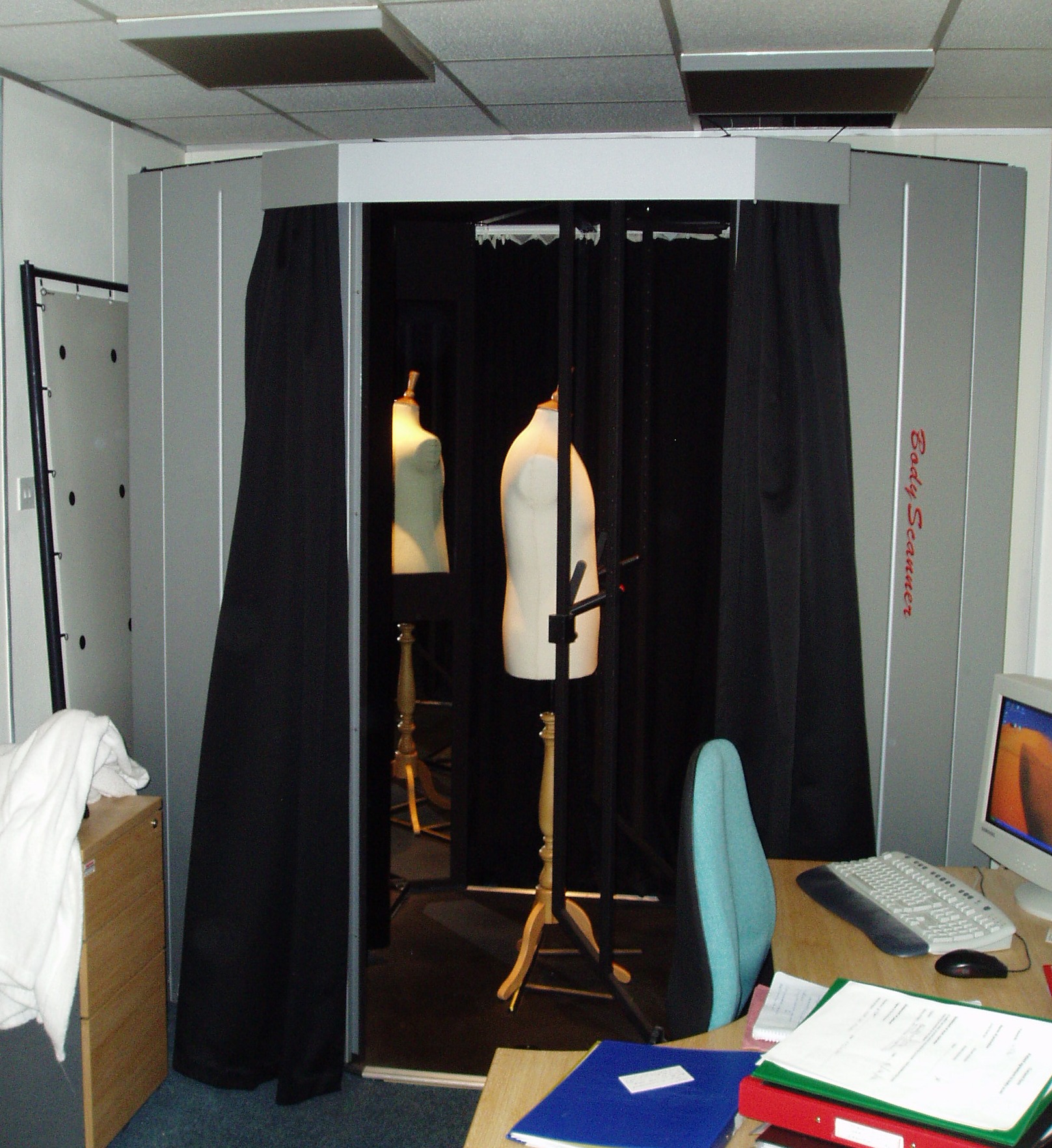
Early Wicks and Wilson body scanning booth with black curtains and dress forms inside.
An early Wicks and Wilson body scanner — an impressive piece of engineering, though not especially portable.

Our scanning equipment has had quite a journey.

We started with a 2D silhouette-scanning booth, used early photogrammetry for several major projects, and later adopted a structured-light system engineered by 3D scanning innovators Wicks and Wilson. The scanner was an impressive feat of engineering, but a major headache whenever we needed to move it.

Successive generations became more portable, although the promise of a scanner in a suitcase occasionally proved optimistic. Let's just say it wouldn't have qualified as cabin luggage.

Along the way, fashion departments, specialist clinics, health clubs and business centres all became homes for the scanner. One university research unit was buried so deep in a rabbit warren of corridors that visitors needed a cautionary note in the invitation: “Please allow extra time to locate the scanner.”

But capturing someone's body shape is one thing. Understanding how they feel about seeing an accurate digital representation is quite another.

A mirror offers a reversed view, usually from a limited range of angles. Photographs flatten a three-dimensional body into two dimensions, with perspective and camera position influencing its appearance. A 3D scan offers a different experience: the opportunity to examine body shape from almost any direction. Colour, texture and photorealistic detail can make a digital body appear more lifelike, yet sometimes distract from, or even obscure, its underlying shape. A simple, untextured model may actually be more revealing.

But do people necessarily want to see themselves in this way? Responses vary. Some find the experience reassuring or informative. Others are surprised by aspects of their shape they have never seen quite so clearly before.

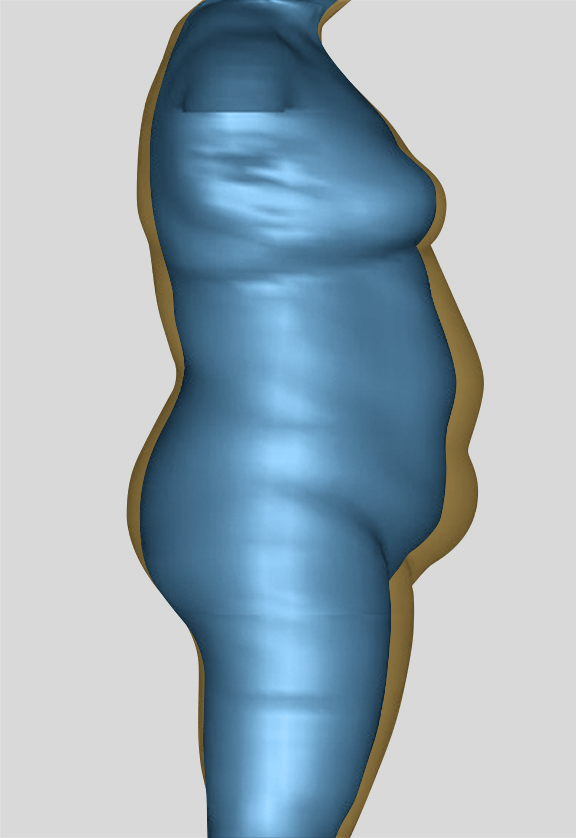
Comparison of body scans showing the later blue surface and the starting gold outline.
Body-shape changes after 12 weeks on a healthy weight programme.

We also began exploring how digital bodies could help us investigate perception itself. We developed software that allowed people to interactively alter the shape of a digital body, providing a way to visualise and quantify aspects of body-image distortion and dissatisfaction. This novel application of 3D body scanning technology attracted interest from television productions and later opened up new research opportunities involving body-image perception and weight management.

The technology also offered a way to explore changes in body shape over time. Rather than relying solely on the bathroom scales, people could create a realistic target body shape and use repeat 3D scans to monitor their progress towards it. We also developed a mobile-friendly 3D viewer so participants could explore their scans on a smartphone or tablet.

These applications raise broader questions about how people experience and respond to digital representations of their bodies. Producing an accurate 3D model does not, by itself, establish whether showing it to someone will be helpful. This has reinforced the importance of involving people in decisions about how technology is developed and used.

Unexpected directions

Research rarely follows a perfectly straight line. New ideas, competing approaches and funding opportunities can all influence its direction.

One particularly unexpected direction led to the formation of Body Aspect itself. When the NHS approached us with a practical problem, we began exploring whether 3D scanning technology originally developed for bra sizing surveys could provide more objective information for assessing women seeking breast surgery. What began as a response to a local need developed into an ongoing clinical assessment service, raising new questions about measurement, fairness and the role of evidence in clinical decision-making.

Our work on digital body manipulation led towards feasibility studies in body image and weight management. In 2014, we had three eating-disorders services interested in exploring the technology. Then came the formidable business of NHS research ethics approval — something we had rather underestimated as a small company. With insufficient time to complete the process, we redirected our efforts towards exploring related questions with gym users and people participating in weight-management programmes at Nuffield Health.

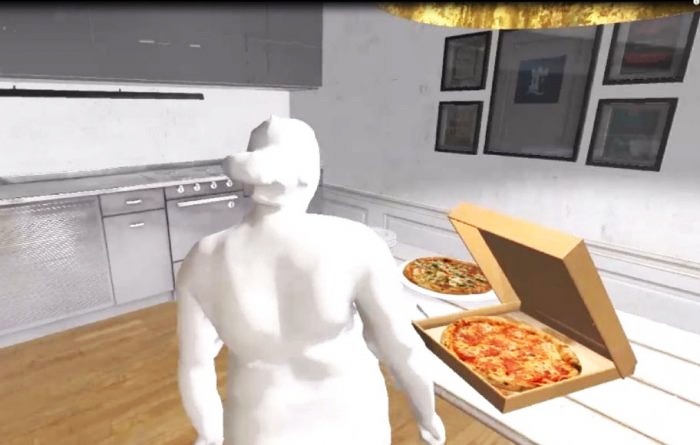
Virtual kitchen scene with a digital person beside an open pizza box on a counter.
Exploring multisensory VR: a virtual pizza, accompanied by real-world scent and airflow.

Later, virtual reality offered another way to experience digital bodies. Instead of viewing a model on a computer screen, people could explore a life-sized 3D representation in an immersive environment — walking around it physically, or using handheld controllers or hand gestures to rotate, reposition and resize the model.

The possibilities extended beyond visual experience. As part of a collaborative feasibility study exploring the potential of VR for eating disorders and weight management, we investigated whether adding other senses could make virtual environments more convincing. This involved delivering the smell of pizza to someone wearing a headset, using a scent device and a strategically positioned fan. It was an unusual experiment, but one that explored the potential of multisensory VR — a promise that remains only partly realised. [Read more: Exploring multisensory virtual reality ]

Then came COVID-19.

Responding to an urgent research call, we rapidly developed an original VR simulation of supermarket shopping under social-distancing conditions. The aim was to explore how shopping environments could be adapted to help people maintain appropriate distances during the pandemic. It was a striking example of how experience developed for one application could be redirected towards a completely different, immediate problem [Watch: VR supermarket social-distancing research]. Ironically, recreating a supermarket for research also got us thinking about the possibilities of actually shopping in virtual reality.

Making technology meaningful

Scanning technology has continued to evolve. Yet technological capability and practical value are not necessarily the same thing.

A clothing retailer needs more than an impressive collection of body measurements: it needs information that can improve garment fit. A clinician needs measurements that are sufficiently reliable and meaningful to support assessment. And the person being scanned may have questions and priorities quite different from either.

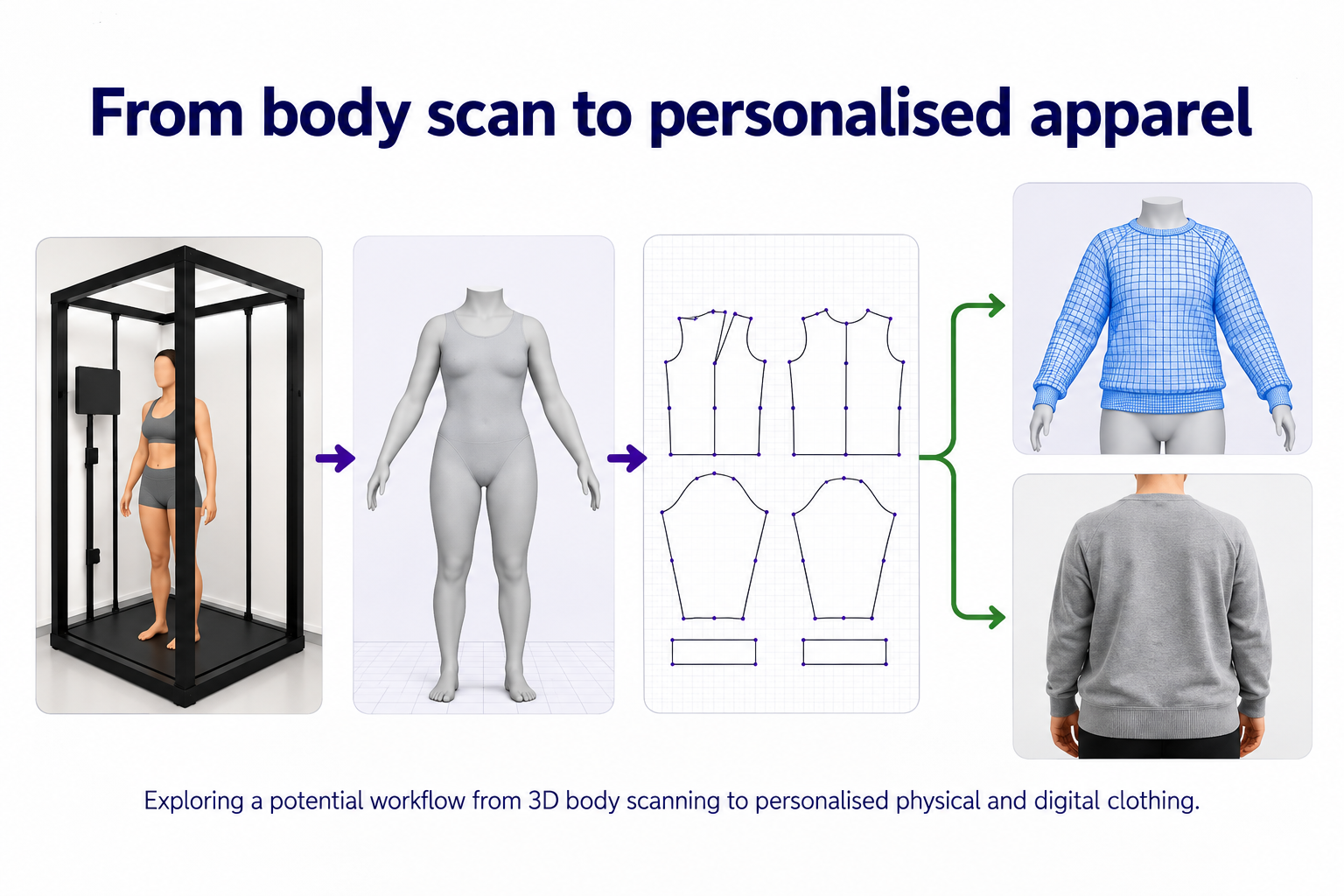
Workflow from a 3D body scan to a personalised avatar and garment pattern, branching into digital and physical garments.

Mass customisation of clothing has been discussed for decades, yet remains surprisingly elusive. Measuring and modelling the body is only part of the challenge; translating that information into well-fitting garments at scale is quite another.

Healthcare brings different complications. A technique that is relatively straightforward to use for clothing or bra fitting may face demanding evidence and regulatory requirements when introduced for medical purposes. Yet established clinical practice has limitations of its own. National guidance on breast reduction surgery still includes bra cup sizing among its assessment criteria, despite its limitations as an objective measure of breast volume. Introducing more reliable approaches into established NHS pathways requires patience, particularly as organisational structures change, policies evolve and some established methods cling to life with a determination that would impress Darwin.

These challenges don't diminish the opportunities for innovation. They help establish what needs to be demonstrated, where expectations should be realistic and which problems are worth tackling. Much of our R&D therefore involves developing ideas, testing their feasibility and working with mathematicians, clinicians and other collaborators. Sometimes that leads towards a practical application. Sometimes it reveals a limitation, an unexpected opportunity or a better question.

Most important of all, we listen to the people whose experiences and perspectives can inform our research. Workshops and in-depth interviews have reinforced something we've encountered repeatedly over the years: people appreciate opportunities to explain their experiences and contribute to the development of technologies that may affect them. Listening to those experiences has been informative, occasionally challenging and a continuing source of motivation.

The next chapter

Advances in AI are renewing interest in extracting measurements and generating 3D body representations from ordinary photographs and smartphones. Some of our older technologies are finding renewed relevance now that AI is mature enough to be useful.

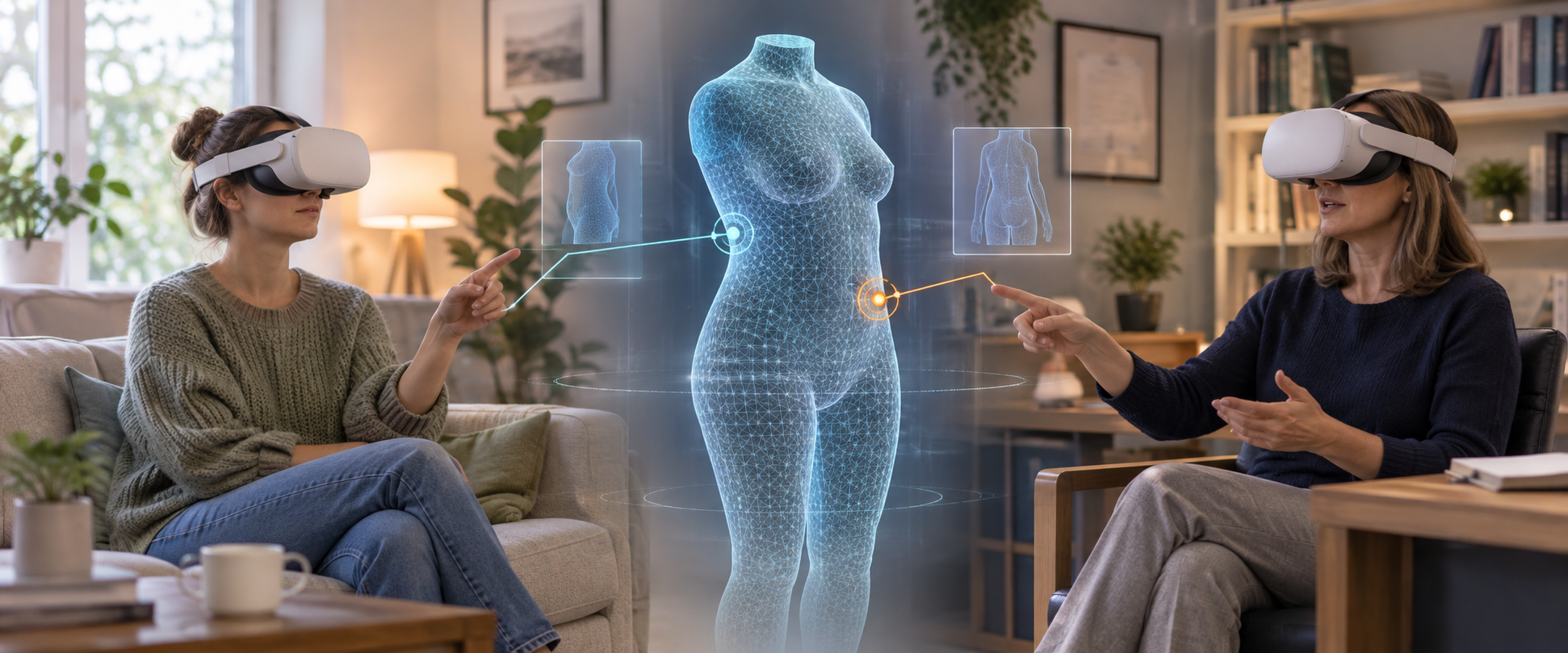
Patient at home and therapist in an office using VR headsets to examine a shared 3D body model.

Developments in digital avatars and immersive technology are opening up new opportunities, while longstanding challenges — such as making clothes that fit the enormous diversity of human shapes — remain surprisingly difficult to solve.

As digital representations become increasingly sophisticated, we're interested in the balance between realism and usefulness. Photorealism has its place, but our focus has largely been on size and shape — and sometimes the detail that makes an avatar look more lifelike can obscure the very features we're interested in.

Our work has generated substantial collections of 3D body-shape data, some of which may offer new opportunities for research. Over the years, we've been encouraged by people's willingness to allow their data to contribute to research that could benefit others.

Where this all takes us next isn't entirely clear. Much will depend on the questions people ask, the technologies that become available, and opportunities to work with others who bring different perspectives.

Some of our most interesting projects have begun with a conversation about a problem we hadn't previously considered. So, what shall we explore next?

Find out more

Contact us today for more information: